The arrival of the monsoon in India brings welcome relief from the summer heat, but it also creates the perfect conditions for one of the world's deadliest creatures to thrive—the mosquito.
Unlike many pests that are simply a nuisance, mosquitoes are responsible for transmitting diseases that affect millions of people globally every year. Mosquito‑borne ailments like dengue, malaria, chikungunya, Zika virus, Japanese encephalitis, and filariasis continue to pose serious public health challenges across India. Yet, what makes the threat from mosquitoes particularly alarming is that it often begins with something as small as a bottle cap filled with rainwater or a forgotten flowerpot on a balcony.
Mosquitoes don't need dirty surroundings to multiply. They only need stagnant water and a few days to complete their breeding cycle. This is why awareness about mosquitoes and their harm potential is far more than a seasonal campaign; it's a year‑round responsibility shared by homeowners, housing societies, schools, hospitals, industries, commercial establishments, and local communities.
At Seva Facility Services Private Limited (SFS), we believe that the most effective mosquito control starts before mosquitoes ever take flight. Our approach is built on education, regular inspections, source reduction, and sustainable mosquito management practices that prevent breeding instead of simply reacting to mosquito infestations. When awareness becomes a habit, healthier communities naturally follow.
Why Mosquito Awareness Matters More Than Ever
Many people think of mosquitoes as nothing more than an irritating part of the rainy season. Unfortunately, they are among the most dangerous disease carriers in the world.
A single infected mosquito has the potential to transmit viruses and parasites that can cause severe illness, prolonged hospitalisation, lost productivity, and even death. Every year, outbreaks of mosquito‑borne diseases place enormous pressure on healthcare systems, businesses, and families in India and the rest of the world.
Rapid urbanisation, changing weather patterns, increased rainfall, water storage practices, and improper waste disposal have created ideal breeding conditions across cities and rural areas alike. Construction sites, residential complexes, industrial premises, schools, office campuses, and even well‑maintained homes can unknowingly become mosquito breeding hotspots.
One of the biggest misconceptions is that mosquitoes breed only in dirty water. This is why mosquito prevention is everyone's responsibility. Municipal authorities alone cannot eliminate every breeding site. Every individual who removes stagnant water contributes to breaking the mosquito life cycle and protecting the wider community.
The Seven‑Day Life Cycle That Makes Prevention So Important
One of the reasons mosquito populations increase so quickly is their remarkably short life cycle — less than two weeks. Under favourable weather conditions, a mosquito can develop from an egg into a flying adult in just seven to ten days.
The life cycle follows four stages: Egg → Larva → Pupa → Adult Mosquito. A single female mosquito can lay between 100 and 300 eggs at one time. These eggs hatch into larvae, which live entirely in water and feed on microscopic organic matter. Within a few days, the larvae transform into pupae before emerging as adult mosquitoes ready to reproduce and perpetuate their kind.
This rapid cycle explains why even a small amount of stagnant water left undisturbed for a week can result in hundreds of new mosquitoes. By the time adult mosquitoes are visible, they may already have completed several breeding cycles. Preventing mosquitoes from breeding is therefore far more effective than dealing with an established infestation.
Hidden Mosquito Breeding Sites You Should Never Ignore
During our inspections, one of the most common observations is that mosquito breeding often occurs in places people rarely think to check. Some of the most common breeding sites include:
- Drain trays below flower pots
- Air‑conditioner drain trays
- Overhead water tanks without tight‑fitting lids
- Desert coolers not cleaned regularly
- Buckets and containers left outdoors
- Coconut shells, discarded tyres, plastic bottles
- Tarpaulins collecting rainwater
- Construction materials, roof gutters blocked with leaves
- Refrigerator drip trays, decorative fountains, bird baths
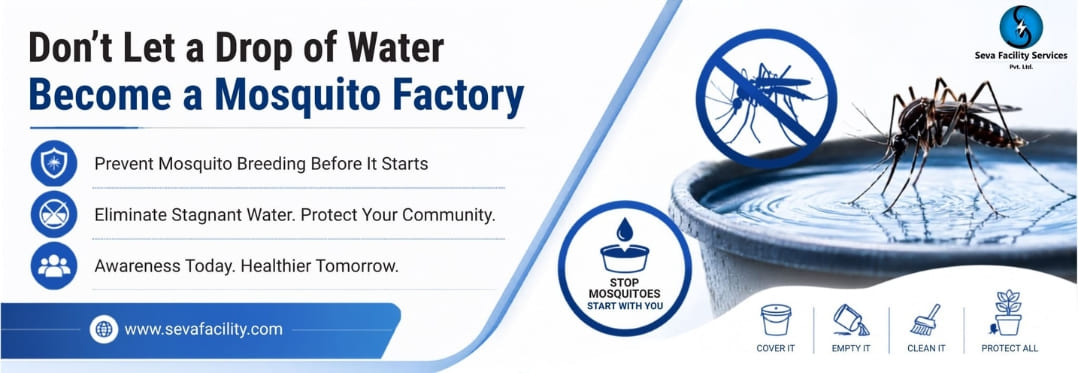
A simple five‑minute property inspection every week can eliminate many of these breeding sites before mosquitoes have a chance to complete their life cycle. Remember, mosquitoes don't need large ponds or dirty drains to multiply. Sometimes, a spoonful of stagnant water is enough to produce hundreds of mosquitoes.
Recognising the Early Signs of Mosquito‑Borne Diseases
Mosquito‑borne diseases often begin with symptoms that resemble a common viral infection. Because of this, many people ignore the warning signs until the illness becomes severe. Early diagnosis and timely medical attention are essential.
- Sudden high fever
- Severe headache, muscle and joint pain
- Pain behind the eyes
- Skin rashes, nausea, vomiting
- Extreme weakness, chills, sweating
- Bleeding gums or nose (in severe dengue cases)
Simple Preventive Measures That Make a Big Difference
Preventing mosquitoes from breeding is far easier and more effective than dealing with an established infestation. Small actions taken consistently can dramatically reduce mosquito populations around homes, workplaces, schools, and industrial premises.
- Empty standing water from flowerpots, buckets, trays, tyres, and containers every week.
- Keep overhead and underground water storage tanks tightly covered.
- Clean roof gutters and drainage channels regularly.
- Trim overgrown vegetation where adult mosquitoes may rest.
- Dispose of unused containers, plastic waste, and coconut shells responsibly.
- Inspect balconies, terraces, parking areas, basements, and construction sites after rainfall.
- Encourage everyone in the household or workplace to participate in weekly mosquito inspections.
No stagnant water means no mosquito breeding.
Innovative Mosquito Traps for Sustainable Management
Modern mosquito control has evolved beyond simply reducing adult mosquito populations. Today, sustainable mosquito management focuses on interrupting the mosquito life cycle before new generations emerge.
Eco BioTrap – Breaking the Mosquito Breeding Cycle
Eco BioTrap is an innovative, eco‑friendly, biodegradable lethal ovitrap designed to attract egg‑laying female mosquitoes. Once mosquitoes enter the trap and lay eggs, the eggs fail to develop into adult mosquitoes, effectively breaking the breeding cycle.
- Attracts gravid female mosquitoes
- Interrupts mosquito reproduction
- Biodegradable and environmentally friendly
- Easy to install and maintain
- Suitable for homes, societies, industries, schools, hospitals, hotels, commercial facilities
MOVITRAP – Smart Indoor Mosquito Monitoring
MOVITRAP is specifically designed to monitor and reduce mosquito breeding inside buildings. By attracting and capturing egg‑laying female mosquitoes, it helps lower mosquito populations before they multiply. Ideal for homes, apartments, offices, hospitals, schools, hotels, and commercial buildings.
Need Professional Mosquito Management?
Contact Seva Facility for a customised Integrated Mosquito Management (IMM) plan.
Request a QuoteIntegrated Mosquito Management (IMM): A Scientific Approach
At Seva Facility Services Pvt. Ltd., mosquito management goes far beyond a single treatment. We follow the principles of Integrated Mosquito Management (IMM) — a comprehensive, science‑based strategy that combines inspection, prevention, monitoring, and control measures to deliver long‑term results.
- Detailed Site Inspection – Identify breeding sources, resting areas, moisture problems.
- Source Reduction – Remove stagnant water before mosquitoes hatch.
- Larval Control – Use approved larvicides and biological methods where water cannot be removed.
- Eco BioTrap & MOVITRAP Deployment – Interrupt breeding and monitor activity.
- ULV Fogging & Thermal Fogging – Rapid reduction of adult populations during outbreaks (supportive measures).
- Routine Monitoring & Follow‑up – Ongoing inspections to prevent new breeding sites.
By combining preventive measures with targeted interventions, Integrated Mosquito Management delivers more sustainable and long‑lasting results than relying on any single control method alone.
Why Choose Seva Facility Services Private Limited?
- Over 30 Years of Industry Experience in pest control and fumigation
- Accredited and certified under national and international standards
- Expert technical team in entomology and environmental science
- Eco‑friendly, sustainable pest management practices
- Pan‑India operations including Pune, Mumbai, Nagpur, Indore, Hyderabad, and more
Our reputation is built on precision, reliability, and science‑backed mosquito management solutions.
Conclusion: Awareness Today, Protection Tomorrow
Mosquitoes may be small, but the diseases they spread can have life‑changing consequences. The encouraging news is that most mosquito‑borne diseases are preventable through awareness, timely action, and scientific mosquito management.
By eliminating stagnant water, adopting Integrated Mosquito Management practices, using innovative solutions such as Eco BioTrap and MOVITRAP, and implementing targeted measures like ULV fogging and Thermal fogging whenever required, we can significantly reduce mosquito populations and minimise the risk of disease transmission.
Health First. Prevention Always.
Mosquito control isn't about reacting to an infestation but about preventing the next generation from ever emerging. Every breeding site identified, every stagnant water source eliminated, and every preventive measure taken today contributes to healthier families, safer workplaces, and stronger communities tomorrow. Together, let's build a future where mosquito‑borne diseases have fewer places to thrive.